As SBTi moves from one-off target validation to a five-year management cycle, companies need to rebuild far more than an emissions-reduction curve. They need board accountability, capital allocation, procurement terms, evidence systems and credible external communications.
The most consequential change in the SBTi Corporate Net-Zero Standard V2.0 is not a new percentage or calculation formula. It is that target-setting and target implementation are now being brought into the same management loop.
Under the earlier model, companies typically established a base year, selected a methodology, submitted targets and obtained validation—then dealt with implementation largely on their own. V2.0 asks harder questions: Who is accountable? Do capital expenditure and procurement decisions support the pathway? Which external constraints could obstruct delivery? How will suppliers and customers be brought into the transition? And what evidence will demonstrate progress five years from now?
That is why companies should treat V2.0 as a management transformation, not merely a standards update.
Start with the timeline: publication does not mean an immediate switch in 2026
V2.0 was formally published on 11 June 2026 and takes effect on 1 February 2027. SBTi expects to begin accepting V2.0 validations in the first quarter of 2027. Companies setting, updating or renewing targets in 2026 are still encouraged to submit under V1.3.1 as soon as possible. During the 2027 transition period, companies may continue to use V1.3.1 until 31 January 2028. From 1 February 2028, all new target submissions must comply with V2.0.
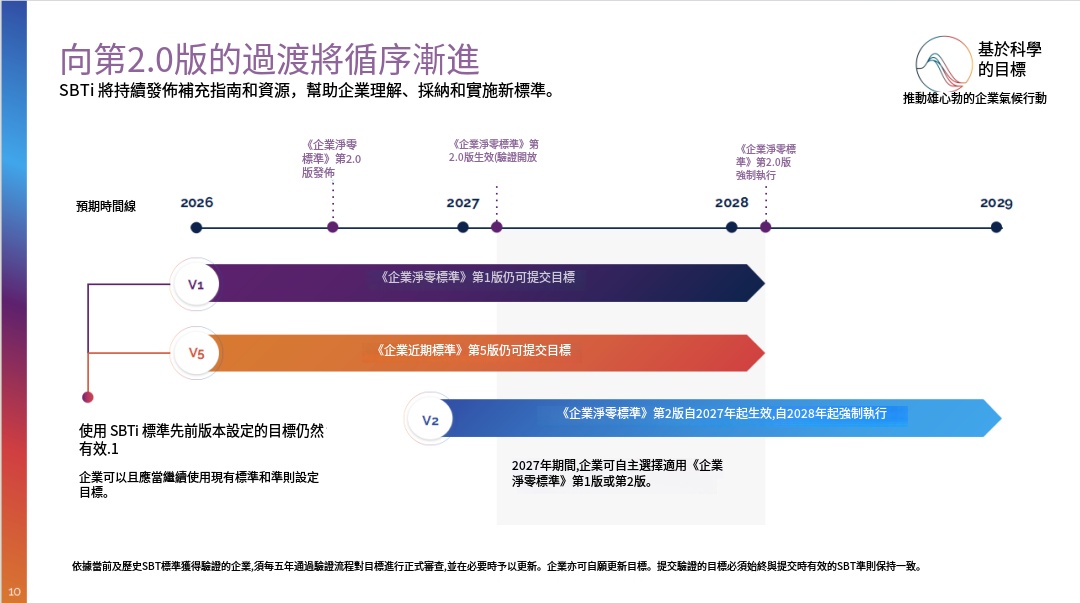
Figure | SBTi standard transition timeline. During the 2027 transition period, companies may use V1.3.1 or V2.0 in accordance with the applicable rules. From 1 February 2028, all new target submissions must use V2.0. Targets validated under earlier versions generally remain valid for their original target period.
For companies with validated targets, existing near-term targets generally remain valid until the end of their original target period. The immediate task is therefore usually not resubmission, but a readiness assessment: identifying which management systems must be strengthened before the next target update.
Determine the company category first: Category A and Category B have different obligations
V2.0 classifies companies as Category A or Category B according to company size and place of registration. Large companies are generally Category A regardless of where they are located. In high-income countries or regions, some medium-sized companies may also fall into Category A based on thresholds for emissions, assets, revenue and employee numbers. Companies that do not meet the Category A criteria are classified as Category B.
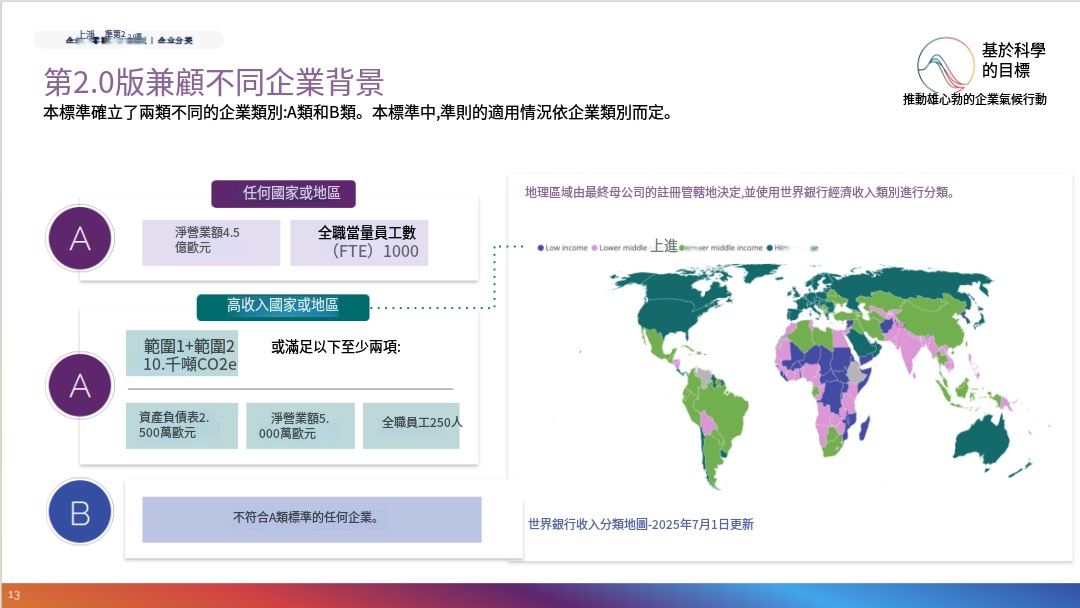
Figure | V2.0 differentiates Category A and Category B companies according to scale and geographic context. Regional income classification is based on the company’s place of registration and the World Bank classification. Companies should confirm their status against the final standard and the latest classification data. Category A companies generally face more comprehensive governance, disclosure, assurance and end-of-cycle assessment requirements.
🔒 訂閱即可繼續閱讀 / Subscribe to continue reading
訂閱即可閱讀本文後續,以及其他訂閱者專屬內容。
Subscribe to read the rest of this article and access other subscriber-only content.
電子郵件 / Email address · 訂閱 / Subscribe · 已經訂閱?登入 / Already subscribed? Sign in