Inside MIT’s 2026 State of Supply Chain Sustainability Report | AI can fill data gaps, not governance gaps
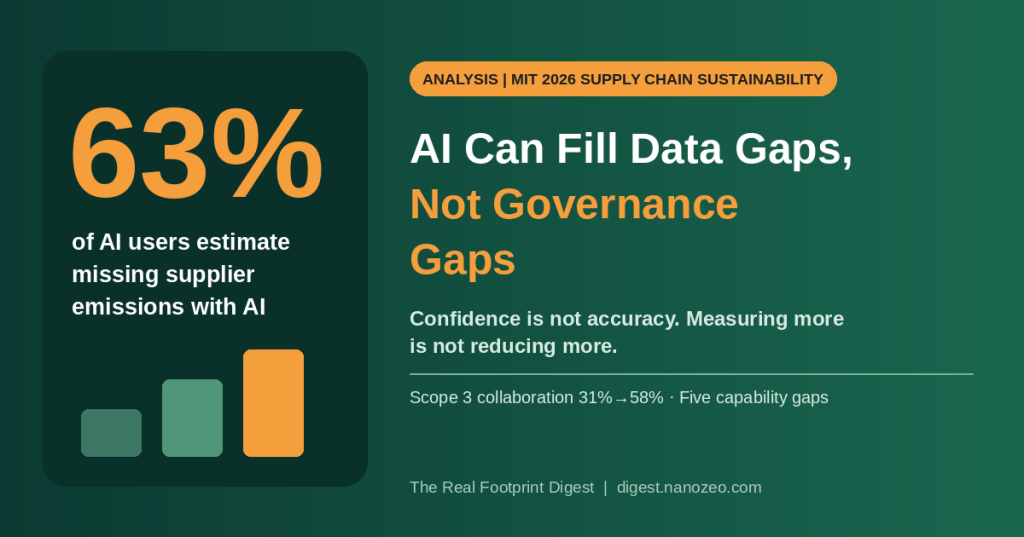
[AI Summary] MIT’s Center for Transportation & Logistics surveyed 1,810 supply chain and sustainability professionals in 91 countries and found that corporate commitment to sustainability is at a seven-year high, but the bottleneck has shifted from “whether to act” to “whether we can deliver”. One number stands out: among AI users, 63.1% use AI to estimate missing supplier emissions data, and these companies are far more confident in their Scope 3 numbers. But confidence is not accuracy, and an estimate does not become supplier-specific data. Scope 3 is turning from separate questionnaires into network collaboration, with participation in joint supplier decarbonization programs rising from about 31% to 58% in one year. For Asian supply chains the lesson is clear: build the data foundation and governance first, and AI will then be able to help.
Key takeaways
- The key numbers in MIT’s report, and why confidence is not accuracy.
- Rereading the report as five capability gaps: commitment, governance, data, decisions and physical transition.
- An LCA/PCF view of AI-filled data: which fields must be kept.
- An action list for Asian suppliers, and four red lines for reading the report.
What is the report about?
State of Supply Chain Sustainability 2026 is the seventh annual report from the Sustainable Supply Chain Lab at MIT’s Center for Transportation & Logistics (MIT CTL). Between February and April 2026 it surveyed 1,810 supply chain, procurement, operations, logistics and sustainability professionals in 91 countries, with companies based in Europe (32%), Asia (28%) and North America (27%). This year’s theme is “Sustainability Under Pressure: AI, Geopolitics, and the Path Forward”.
The headline: 83% of respondents rate sustainability as important to long-term business success, a seven-year high, yet 68% say tariff uncertainty has forced them to delay, scale back or compromise sustainability strategies. In the report’s words, the will to act is stronger, but the room to act is shrinking.
One number, one contrast: confidence is not accuracy
| How companies use AI for emissions measurement | Share |
|---|---|
| Estimating emissions where supplier data are missing | 63.1% |
| Collecting and aggregating emissions data from multiple sources | 62.5% |
| Automating Scope 1–3 carbon accounting and reporting | 53.5% |
| Identifying emissions hotspots in the supply chain | 43.4% |
| Simulating emissions under different supply chain scenarios | 24.7% |
The same report finds that 50.5% of companies using AI for emissions tracking are “very confident” in the accuracy of their Scope 3 data, against only 15.3% of those that do not. The report itself notes that this is a correlation, not proof that AI makes the data more accurate.
That is the crux. A number estimated by AI from spend, industry averages or similar materials is still a modelled or proxy value. Unless it can be traced back to that supplier, that product and that period’s activity data, it cannot be labelled supplier-specific data. AI can fill data gaps, not governance gaps — and measuring more is not the same as reducing more.
Rereading the report as five capability gaps
| Layer | What MIT found | What it means |
|---|---|---|
| Commitment | 83% rate sustainability as important to long-term success | Whether to act is no longer the main debate |
| Governance | Only 51% of companies with public goals have a formal cross-functional team; 33% have board-level oversight and 15% have no formal oversight | Commitments have not yet become decision rights, budgets and accountability |
| Data | Asia’s top challenges include end-to-end visibility and supplier compliance; carbon software and spreadsheets are each used regularly by about 75% | Plenty of tools, but the data pipeline is not yet connected |
| Decisions | Sustainability enters transport (39%), procurement (35%) and warehousing (34%) most; capital investment and network design least | Companies improve operations, but rarely redesign the supply chain |
| Physical transition | 43% of fleets still run entirely or mostly on diesel; 29% of mature AI users perceive higher total emissions | A gap remains between efficiency gains and physical reductions |
Seen this way, AI is at most an accelerator for the data and decision layers. It does not replace governance, and it is not the physical transition itself. That is how “87% of AI adopters report a positive impact” can sit alongside “29% perceive higher total emissions”: the first mostly reflects local process efficiency, the second is closer to the system-level outcome.