China’s Ministry of Commerce has translated the EU Carbon Border Adjustment Mechanism (CBAM) into 20 questions that companies actually ask. For Taiwan and Southeast Asia, the real lesson lies not only in the answers, but in how China converts European rules into operational work across customs classification, emissions accounting, verification, contracting and enterprise systems.
By Raymond Wang · SSBTi 2026 | Regulatory status reviewed on September 7, 2026
The central argument: Studying a competitor does not mean endorsing it, and understanding another system does not mean copying it. Taiwan and Southeast Asia need to understand Europe’s regulations, standards and verification architecture; study the speed with which China turns rules into manufacturing and supply-chain action; and then build methodologies of their own.
1. The bottom line: CBAM is no longer a carbon-tariff knowledge test. It is a supply-chain governance test.
The EU Carbon Border Adjustment Mechanism entered its definitive regime on January 1, 2026. The central challenge has moved beyond whether a transitional report must be filed. Companies now face six questions that can directly affect orders and margins: Is the product covered? How are embedded emissions calculated? When may default values be used? How are actual values verified? How can upstream evidence be obtained? And who ultimately bears the cost?
Legally, the authorized CBAM declarant in the EU is generally responsible for declarations and certificate surrender. Commercially, however, data costs, verification fees, unfavorable default-value gaps and certificate-price risk can all travel back through purchase orders to Asian suppliers. A company in Taiwan or Southeast Asia may not be the statutory payer, but it cannot treat CBAM as the customer’s problem alone.
2. Why does SSBTi study China’s CBAM Q&A?
In Taiwan and across Southeast Asia, discussions of China or the so-called “red supply chain” naturally raise concerns about politics, security and market dependence. Those concerns should not be minimized. Yet risk awareness and institutional learning are not mutually exclusive. Precisely because reservations exist, companies should examine how China studies markets, translates regulation, organizes industry and rapidly converts compliance requirements into supply-chain action.
Two major methodological forces increasingly shape sustainability governance in Asian manufacturing:
- Europe: strong in regulation, standards, disclosure systems, verification architecture and market-access conditions.
- China: experienced in manufacturing at scale, supply-chain integration, policy translation and industrial implementation.
- Taiwan and Southeast Asia: should not passively receive either side’s rules. They need to convert both into their own product data, customer service and negotiating power.
The Trade Development Bureau of China’s Ministry of Commerce organized experts to prepare the first edition of its EU CBAM Knowledge Q&A. Its value lies not merely in 20 answers, but in the way it turns an abstract regulatory system into questions that arise on factory floors and in commercial negotiations: Is office furniture covered? Is a customer’s proposed 35% surcharge reasonable? Are emissions data required at customs clearance? Who selects the verifier? Does renewable electricity help? Can a trader aggregate data? Can the transitional Excel template still be used? This method—working backward from real questions to enterprise processes—is worth studying.
3. Five foundational judgments
- Determine the eight-digit EU CN code before discussing carbon. A finished product is not necessarily covered merely because it contains steel or aluminum.
- Separate legal responsibility from commercial responsibility. The EU importer files the declaration and surrenders certificates, but Asian suppliers may still face data and cost pressure.
- Actual values are valuable only when they are verifiable. A number without a facility, period, product, methodology and verification report is not usable evidence.
- The CBAM boundary is not the same as an ISO 14067 product carbon footprint. The same decarbonization investment may improve the full footprint without necessarily reducing the current CBAM liability.
- The definitive regime cannot run on one spreadsheet. Companies ultimately need a traceable chain linking products, materials, processes, evidence, verification and cost.
4. Twenty-question deep dive: source answer × SSBTi analysis × business action
Question 1 | If a product contains steel or aluminum, is it automatically covered by CBAM?
Source question and answer: Is steel or aluminum office furniture classified under customs code 940310 within CBAM scope? At present, no. Coverage is determined by the EU CN codes listed in the CBAM legislation—not simply by a product’s name or material content.
SSBTi analysis: This is the first gate in the entire system. A sales team that sees steel and immediately adds a surcharge can be wrong; a sustainability team that sees carbon and immediately begins accounting can also be wrong. Product applicability is first a customs-classification question and only then an emissions-accounting question. Taiwan’s CCC codes, Chinese customs codes and EU CN codes can inform one another, but they are not automatically identical. Products with similar names can fall under different codes because of their function, construction or intended use.
- Primary risk: False inclusion creates unnecessary cost; false exclusion creates compliance and order risk for the customer.
- Business action: Build a master file linking SKU, product description, eight-digit EU CN code, CBAM flag, classification rationale and responsible approver. Obtain written confirmation for high-risk products from the EU importer or a customs specialist.
Question 2 | A customer claims CBAM costs equal 35.85% of the selling price. Is that reasonable?
Source question and answer: In the example of a galvanized-steel access panel, the chargeable emissions under the most unfavorable default value are 3.384 − (1.364 × 0.975) = 2.054 tCO₂/t. At a certificate price of €75.28, the cost is about €154.63 per tonne. For individual products weighing 4.2 kg and 0.65 kg, this is approximately €0.65 and €0.10—far below 35.85% of the selling price.
SSBTi analysis: CBAM is not, in principle, a flat percentage applied to product revenue. A defensible cost chain should identify product weight, embedded-emissions intensity, the free-allocation adjustment, the applicable quarterly certificate price and any effectively paid carbon price in the country of origin. A “carbon tariff” expressed only as a percentage, with no calculation workpaper, may include a risk premium, administrative cost or bargaining strategy rather than a strict regulatory charge.
- Primary risk: The buyer uses information asymmetry to transfer all future uncertainty to the supplier in advance.
- Business action: Request five items: CN code, net product weight, emissions intensity, certificate price, and all adjustments or deductions. Quote base, high and default-value scenarios instead of accepting one percentage.
Question 3 | Before customs clearance in 2026, must customs already have the producer’s emissions data?
Source question and answer: The definitive regime uses the calendar year as its reporting period, so annual data for products imported in 2026 are declared in 2027. The key requirement at 2026 customs clearance is that the EU importer holds the appropriate declarant authorization—not that complete annual producer data accompany every shipment.
SSBTi analysis: Companies must distinguish a legal customs-release requirement from a customer’s purchasing condition. A buyer may reasonably request provisional data before shipment to estimate costs, obtain internal approval or avoid chasing suppliers at year-end. But that commercial control should not be misrepresented as final verified data legally required at the border for every consignment.
- Primary risk: Provisional data are labeled “final” and later conflict with the verified annual result.
- Business action: Mark every early data delivery with its version, period, methodology and provisional status. Contractually define year-end recalculation and correction procedures.
Question 4 | Must CBAM certificates be surrendered with every customs clearance in 2026?
Source question and answer: Certificates are not surrendered shipment by shipment at customs in 2026. The annual declaration and surrender for 2026 imports take place in 2027 under the definitive-regime timetable. The European Commission currently states that certificates will be purchased through the common central platform from February 2027, and the first 2026 declaration and certificate-surrender deadline is September 30, 2027.
SSBTi analysis: “No payment at each shipment” does not mean “no 2026 cost.” EU importers will still estimate carbon-cost liabilities by quarter and may seek to pass differences back to suppliers through pricing. Contracts need to state when costs are recognized, who finances them, how price changes are settled and who bears additional certificates or penalties caused by erroneous supplier data.
- Primary risk: A contract merely says “the supplier is responsible for CBAM,” without a liability cap, price source or error-allocation rule.
- Business action: Separate the statutory obligor, data provider, verification fee, certificate cost, price benchmark and annual true-up into distinct clauses.
Question 5 | What does one tonne of emissions cost, and how should carbon pricing enter a quotation?
Source question and answer: Each tonne of chargeable CO₂ corresponds to one CBAM certificate. For 2026, certificate prices are based on quarterly averages of EU ETS auction prices; from 2027 onward, weekly averages apply. The EU published a price of €75.28 for the second quarter of 2026.
SSBTi analysis: The certificate price is a variable, not a fixed tariff. Hard-coding one quarter’s price into an annual quotation makes the supplier absorb carbon-price, exchange-rate, import-timing and emissions variances. Finance systems should separate the physical flow from the price flow. The physical ledger records product weight and chargeable emissions; the price ledger records the relevant quarterly or weekly certificate price, euro exchange rate and carbon-price deductions.
- Primary risk: Carbon cost remains hidden in gross margin until the annual settlement reveals that the quotation was wrong.
- Business action: Create a recalculable Carbon Cost Ledger recording at least the import quarter, chargeable emissions, official price, exchange rate, origin-country carbon-price deduction and customer allocation.
Question 6 | If full-year data are not complete until 2027, can companies wait before preparing?
Source question and answer: The final annual data and verification result for 2026 will not be complete until 2027, but non-EU producers should still obtain upstream precursor data and verification evidence in advance.
SSBTi analysis: The fact that the result is annual means the monitoring design must begin at the start of the year. A company that waits until 2027 to reconstruct its 2026 fuel, output, work-order, scrap and upstream-material records will usually find inconsistent definitions, missing source evidence and allocations that cannot be defended. Verification does not repair a company’s data; it tests whether the data support the conclusion.
- Primary risk: The company has an annual total but cannot allocate it to facilities, processes, products and precursors.
- Business action: Follow the sequence of monitoring plan → full-year accumulation → internal QA → independent verification. Perform a monthly data-completeness close.
Question 7 | Who selects the verifier, and may the customer appoint one?
Source question and answer: Actual-emissions data must be verified by an independent verifier accredited by a national accreditation body in an EU Member State. An exporter may select an eligible verifier and is not necessarily limited to the importer’s preferred provider.
SSBTi analysis: Regulatory eligibility and acceptance within a customer’s process are different questions. Even if an organization appears qualified, the company must confirm that its accreditation scope covers the relevant industry, country and activity. It should also confirm report language, deliverable format, site-visit capacity and compatibility with the customer’s systems. The Commission expects the first verifiers to begin receiving accreditation around September 2026. Companies should check official listings and accreditation certificates.
- Primary risk: A company pays for verification and later discovers that the accreditation scope or customer process does not accept it.
- Business action: Before contracting, request the accreditation certificate, scope, validity period and official-listing link, and obtain written acceptance from the EU importer.
Question 8 | Must a downstream verifier re-verify every upstream plant?
Source question and answer: Upstream precursor producers should calculate and verify their own data. A downstream plant uses those verified reports as evidence, combines them with its own process emissions and consumption data, and completes its own calculation and verification. The downstream verifier does not generally repeat the entire upstream engagement.
SSBTi analysis: Evidence can be inherited along the supply chain, but responsibility cannot be discharged by forwarding a PDF. The downstream plant must still prove that the material actually came from the reported facility, applies to the correct period and product, and is covered by the quantities in the verification report. An emissions factor without a source facility, reporting period and verification opinion cannot support a downstream claim.
- Primary risk: The report is genuine but is applied to the wrong factory, product, period or batch.
- Business action: Build a Supplier Evidence Package covering supplier, facility, product or CN code, emissions intensity, methodology, period, verification opinion, applicable quantity and version.
Question 9 | How should companies assess providers claiming to be “CBAM-qualified verifiers”?
Source question and answer: When the handbook was published, the first formal CBAM verifier accreditations were still being established. Accreditation is granted by national accreditation bodies in EU Member States, and companies should rely on official EU information as lists develop.
SSBTi analysis: The market often blurs three different services: a CBAM readiness assessment, conventional ISO greenhouse-gas verification and formal CBAM verification. The first two can support preparation, but they do not automatically replace the third. Procurement documents must state whether the deliverable is a readiness review, calculation support or a formal verification opinion usable in a CBAM declaration.
- Primary risk: “Familiar with CBAM” is mistaken for “formally accredited for CBAM.”
- Business action: Prohibit vague claims in the contract. Require the accreditation number, scope, national accreditation body, validity period and registry status.
Question 10 | Can the same organization calculate a company’s emissions and then verify its own work?
Source question and answer: No. To preserve independence and impartiality, calculation or reporting support must be separated from final independent verification, with conflicts of interest avoided.
SSBTi analysis: Outsourcing methodology design, data preparation, calculation, anomaly correction and verification to one team may appear efficient, but it destroys clear accountability. The right architecture is: the company owns and is responsible for the data; an adviser supports methodology and systems; and the verifier independently evaluates the result. Even when one corporate group offers multiple services, the client must confirm the legal entities, team separation and conflict controls.
- Primary risk: An “all-in-one calculation and verification” package is rejected for lack of independence, forcing the annual data to be redone.
- Business action: Separate scopes of work, procurements, deliverables and payment milestones, and require a written independence and conflict-of-interest declaration.
Question 11 | Can a trader average data from different factories and submit it for verification under the trader’s own name?
Source question and answer: Generally, no. The central responsibility for emissions calculation and verification lies with the actual production installation. A trader may coordinate data exchange, but it should not package data from several factories as though they represented one production process of its own.
SSBTi analysis: The trader’s greatest value will evolve from consolidating physical shipments to managing data lineage. If one SKU is supplied by three factories, the company must know which installation produced each batch and which emissions data and verification report apply. An untraceable average conceals differences between higher- and lower-carbon suppliers and prevents a buyer from using the better actual value.
- Primary risk: The source of goods changes, but the lower-carbon data from the original factory continue to be used.
- Business action: Establish data lineage across factory, product, batch or period, quantity and evidence file. The trader should act as a data coordinator—not impersonate the producer.
Question 12 | Does CBAM always include emissions from purchased electricity?
Source question and answer: Under the current definitive-regime boundaries, most iron and steel products—with certain exceptions—as well as aluminum and hydrogen primarily include direct emissions. Specific products such as cement and fertilizers also require treatment of indirect emissions. Companies cannot apply one electricity-emissions rule to every product.
SSBTi analysis: CBAM, ISO 14067, EPDs, SBTi and customers’ Scope 3 accounting serve different purposes and use different boundaries. An emission source excluded from CBAM does not cease to exist and may still be required elsewhere. Companies should build one complete underlying data foundation and map it into different regulatory or reporting outputs—not maintain a different, contradictory spreadsheet for each framework.
- Primary risk: CBAM’s narrower boundary is mistaken for the company’s full decarbonization boundary, leading to poor investment and disclosure decisions.
- Business action: Build a complete emissions data foundation with framework-specific mapping layers, clearly identifying direct emissions, indirect emissions, precursors and framework applicability.
Question 13 | Does purchasing renewable electricity automatically reduce CBAM costs?
Source question and answer: Not necessarily, as shown by the handbook’s aluminum-processing example. If a plant has no direct combustion emissions and indirect electricity emissions are not currently included for that product, the CBAM result is driven mainly by the precursor aluminum and its consumption ratio.
SSBTi analysis: This does not mean renewable electricity lacks value. It means the company must identify which number, under which framework, an investment will reduce. Renewable electricity may still lower organizational Scope 2 emissions, a full product carbon footprint, customers’ Scope 3 emissions and SBTi target performance. But to reduce the current CBAM cost of that aluminum product, the higher-priority levers may be lower-carbon precursor aluminum, better material yield, lower consumption and verifiable material segregation.
- Primary risk: The entire decarbonization budget goes to renewable electricity while the upstream material that actually determines CBAM cost remains unchanged.
- Business action: Conduct a framework-specific hotspot analysis before allocating investment among renewable power, lower-carbon materials, process improvements and supplier substitution.
Question 14 | If a downstream processor has no direct emissions, can it avoid verification?
Source question and answer: Verification may still be required. The verifier does more than confirm combustion emissions. It must assess whether direct emissions have been omitted from the system boundary and examine precursor consumption, output, allocation and the final embedded-emissions calculation.
SSBTi analysis: “Zero” is not an exemption; it is a conclusion that requires evidence. A plant may have no primary combustion equipment yet still need to assess backup generators, heating, process gases, mobile sources or shared equipment. Even when direct emissions are genuinely zero, the BOM, yield, scrap, rework and precursor factors still affect the finished-product result.
- Primary risk: The plant demonstrates a zero energy bill but cannot demonstrate material mass balance or a complete system boundary.
- Business action: Prepare a zero-emission evidence memorandum supported by an equipment register, site review, material flow, allocation methodology and precursor evidence.
Question 15 | Can the Excel template used during the transitional period continue in the definitive regime?
Source question and answer: Excel may remain useful as a calculation or data-exchange workpaper, but the transitional template alone cannot replace the monitoring plan, annual emissions report, verification and registry workflow required in the definitive regime.
SSBTi analysis: The problem with Excel is not its formulas; it is governance. Who can make changes? Are versions consistent? Where is the source evidence? Which products are affected when supplier data change? Can the result be reproduced after the annual close? As products, factories, suppliers and customers multiply, a single file quickly loses traceability.
- Primary risk: Critical formulas are overwritten, versions are mixed, and evidence is scattered across email and personal computers.
- Business action: Use Excel as an interface, not the sole source of truth. Gradually connect master data, activity data, document versions, approvals and exception checks to ERP, MES, energy and ESG systems.
Question 16 | Must every SKU be calculated separately, or may products be grouped?
Source question and answer: The basic starting point is the eight-digit EU CN code. Products that differ only in dimensions or shape and use the same precursor types, consumption ratios and production routes may have some scope for grouped calculation, subject to the definitive rules and guidance.
SSBTi analysis: Excessively broad grouping conceals differences, while excessive granularity makes maintenance unmanageable. A Product–CN Code–Route model provides three useful layers: map commercial SKUs to CN codes, then group them by material recipe and production route. Similar product names are not the test; homogeneity of precursors and production pathways is.
- Primary risk: Different materials, factories or processes are forced into one average for convenience.
- Business action: Define grouping rules, variance thresholds, approvers and annual review. Preserve the mapping from each SKU back to its group and source data.
Question 17 | Is it enough to classify only products currently exported to the EU?
Source question and answer: The handbook recommends mapping eight-digit EU CN codes for all products manufactured by the plant—including exported and non-exported products, and CBAM and non-CBAM products. When products share production lines, the types and volumes of non-CBAM products may affect emissions allocation.
SSBTi analysis: This is a completeness control. Calculating only EU orders may ignore equipment, fuel or processes shared with products for other markets and thereby distort the denominator. Multi-country manufacturers in Southeast Asia face an additional issue: SKUs, customs classifications and ERP masters are often maintained by different teams. Without a group-wide rule, comparisons across plants become unreliable.
- Primary risk: A shipment list overlooks co-produced goods, domestic products, semi-finished products or rework flows.
- Business action: Build a complete product master first, then filter it with a CBAM flag. Keep non-CBAM products in the model as output denominators and completeness evidence.
Question 18 | How should one precursor sourced from multiple suppliers be calculated?
Source question and answer: In principle, data are weighted according to actual purchasing or consumption proportions. Use actual values where verified actual data exist and permitted default values where data cannot be obtained. If the company can prove that a specific process used material from only one supplier, that supplier’s actual value may be applied to that process.
SSBTi analysis: The key is not simply to create an average; it is to prove the material flow. Purchasing ratios may not equal consumption ratios because opening inventory, cross-period issues, returns, scrap and substitute materials create differences. If a company purchases lower-carbon aluminum but cannot prove which EU product batch consumed it, that advantage may be diluted by higher-carbon or default-valued materials.
- Primary risk: A purchasing commitment is treated as proof of physical use, and the value of lower-carbon material cannot be passed to the customer.
- Business action: Link supplier lots, goods receipt, storage location, work order, BOM, substitute material and finished-product batch. Where necessary, implement material segregation or a verifiable mass-balance rule.
Question 19 | If upstream precursors use actual values, may the company’s own process use a default value?
Source question and answer: In principle, no. Precursors may use actual values or permitted default values under the rules, but the subsequent processes controlled by the producer must still be calculated using actual data. If the company’s own process cannot be calculated, the finished product may need to fall back to an overall default-value pathway.
SSBTi analysis: A default value is a regulatory fallback where permitted—not a plug for internal data-governance gaps. The data a company should clean first are the data it controls: fuel, process gases, output, yield, scrap and allocation. Missing upstream data can be negotiated or the supplier replaced. Missing internal data reveal a management-capability problem.
- Primary risk: Externally sourced data are complete, but the internal process cannot be reproduced, invalidating the overall actual value.
- Business action: Apply “Clean before Scale”: establish one traceable actual-data pathway for one factory and one product route before expanding across factories and SKUs.
Question 20 | Must every non-EU producer register in the CBAM Registry or Operators Portal?
Source question and answer: A non-EU producer may use the Operators Portal to manage installation, product, emissions and verification data and share them with declarants. Whether registration is necessary depends on the rules, the number of customers and the data-transfer model; not every company is limited to one method of delivery.
SSBTi analysis: A platform can reduce the cost of repeatedly sending the same data to multiple customers, but it also creates access-control and trade-secret risks. One sales representative should not upload data independently. The company must first define the data owner, which customers may see which products and periods, how verification reports are updated, how old versions are withdrawn and how access is revoked when employees or agents change.
- Primary risk: Convenient sharing leads to excessive disclosure of suppliers, recipes, volumes or plant-level commercial information.
- Business action: Establish registry governance covering roles, permissions, customer scope, versions, approvals, withdrawal, audit trail and retention.
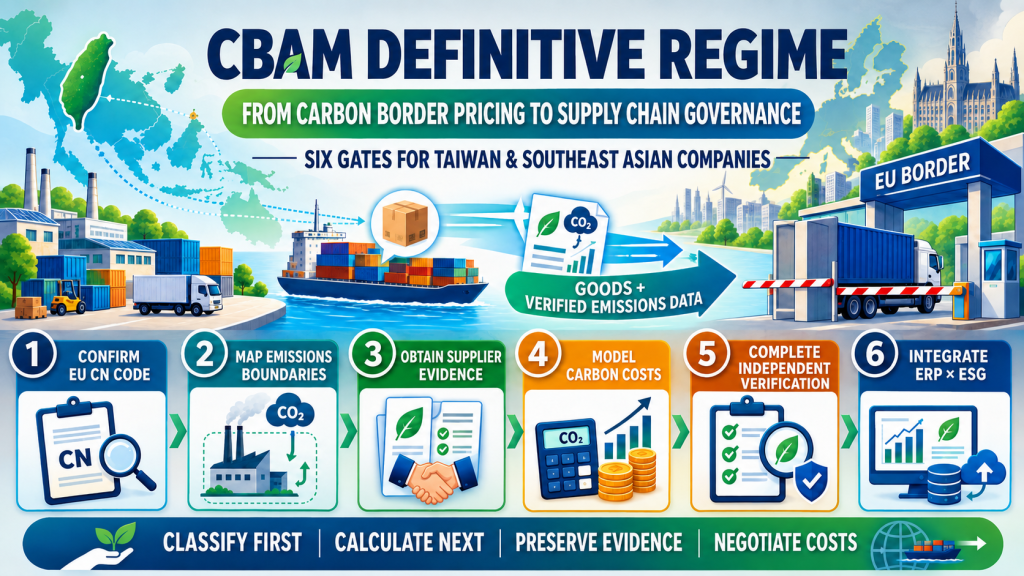
5. Converting 20 questions into six business gates
- Gate 1 | Applicability: Complete EU CN-code and CBAM-scope mapping for the full product portfolio.
- Gate 2 | Data readiness: Establish the monitoring plan, installation boundary, emissions-source flow, metering points and annual close.
- Gate 3 | Supply-chain evidence: Obtain actual values, verification reports and applicable quantities from key precursor suppliers.
- Gate 4 | Calculation test: Select representative SKUs and run the BOM, mass balance, allocation and carbon-cost scenarios end to end.
- Gate 5 | Independent verification: Confirm accreditation, industry scope, independence and customer acceptance.
- Gate 6 | System integration: Connect products, materials, activity data, evidence and cost through ERP, MES and ESG APIs.
6. CBAM is not a sustainability-department project: six functions share responsibility
| Function | Primary responsibility | An answer that is not enough |
|---|---|---|
| Customs / Legal | CN code, legal applicability, importer role | “The product contains steel or aluminum, so it must be covered.” |
| Sustainability / EHS | Monitoring plan, boundary, emissions calculation and QA | One company-wide emissions total |
| Procurement | Supplier actual values, verification evidence and improvement clauses | A single factor copied from a supplier email |
| Production / Quality | Output, yield, scrap, batch and mass balance | An annual average consumption figure |
| Finance / Sales | Price scenarios, cost allocation and customer contracts | A carbon-tariff percentage with no workpaper |
| IT / Data Governance | Master data, versions, permissions, interfaces and audit trail | One spreadsheet scattered on a personal computer |
7. A 90-day roadmap for Taiwan and Southeast Asian companies
Days 1–30 | Define scope and accountability
- Select the 20 highest-volume EU-bound SKUs and all potentially affected plants.
- Complete an initial EU CN-code assessment and obtain written confirmation for high-risk items.
- Establish a RACI covering customs, sustainability, procurement, finance, sales and IT.
- Review customer contracts for allocation of CBAM cost, data-error liability and verification fees.
Days 31–60 | Run one representative product through the full process
- Trace the finished-product SKU through its BOM, precursors, suppliers and source installations.
- Map direct emissions sources, meters, output, yield, scrap and products sharing the same production line.
- Develop both actual-value and default-value cost scenarios.
- Assemble a Supplier Evidence Package and test whether the finished product can be traced back to source evidence.
Days 61–90 | Move from estimation to verification readiness and scale
- Perform a verification readiness assessment.
- Correct data gaps, allocation rules and document-version problems.
- Integrate high-frequency fields into ERP, MES and ESG systems and define the annual close.
- Confirm data format, verifier acceptance and the annual true-up mechanism with EU customers.
8. SSBTi’s final assessment: learn from competitors without copying them
The most valuable lesson in this Chinese Ministry of Commerce Q&A is not that every answer should be treated as permanent law. It is the capability the document demonstrates: translating hundreds of pages of European rules into questions that companies can answer, calculate, verify and negotiate.
Taiwanese companies cannot remain satisfied with being “more familiar with international standards,” and Southeast Asian companies cannot rely only on cost and capacity. As CBAM, ESPR, digital product passports, product carbon footprints and supply-chain Scope 3 requirements converge, competitiveness will depend on who can explain the origin, process, emissions, evidence and cost of every SKU—and deliver data that customers can actually use.
CBAM will not be won by filling out a form. It will be won by building a credible, verifiable and recalculable product data chain.
Classify first, then calculate. Preserve evidence before negotiating cost. Clean the data you control before scaling across the supply chain.
Sources and regulatory note
- China Ministry of Commerce | EU CBAM Knowledge Q&A (First Edition)
- European Commission | CBAM definitive regime
- European Commission | Verification of CBAM emissions
- European Commission | Price of CBAM certificates
- European Commission | CBAM legislation and guidance
This article is intended for policy research, corporate education and supply-chain governance. It does not constitute legal, customs or verification advice. CBAM rules, product scope, default values, verifier listings and declaration procedures may continue to change. Actual compliance should follow the legislation and current European Commission guidance, the competent authority in the importing Member State and the requirements of the authorized CBAM declarant.
 The Real Footprint Digest
發表留言