Green Export Compliance Field Notes Vol.4 | Apparel moves to DPP first; footwear gets its data right first
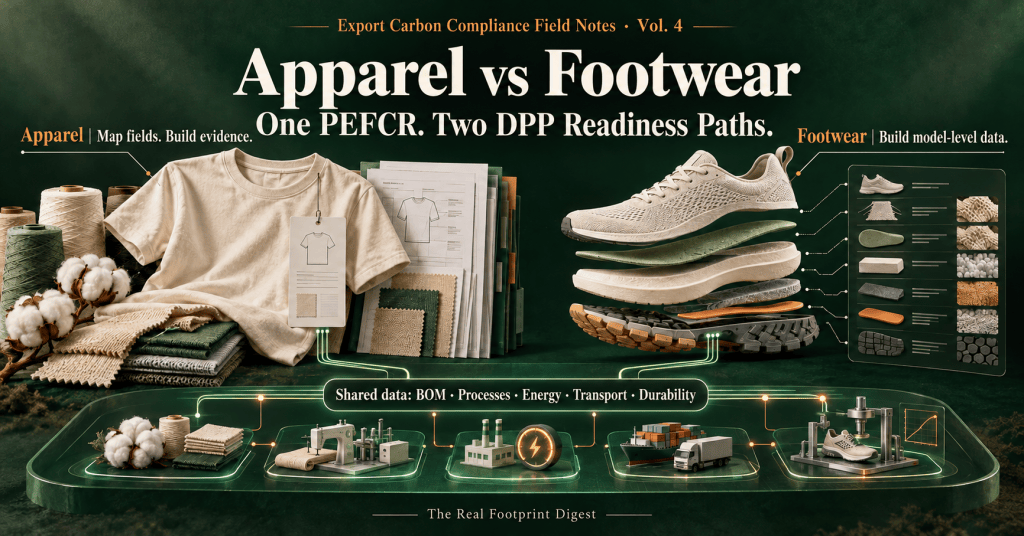
[AI Summary] The EU Apparel and Footwear PEFCR v3.1 was approved by the European Commission in May 2025. One set of rules covers 13 sub-categories: 1–10 are apparel, swimwear and clothing accessories; 11–13 are open-toe footwear, closed-toe footwear and boots. The calculation method is the same, but the Digital Product Passport (DPP) timelines differ: textiles/apparel is on the ESPR 2025–2030 working plan priority list, the JRC published a study on DPP data content in May 2026, and the delegated act is expected around 2027 (estimate); footwear is not on the priority list and has no DPP timeline yet. What both already face is the ban on destroying unsold apparel and footwear, and the Empowering Consumers Directive (EmpCo), applicable from September 2026, which prohibits unsubstantiated environmental claims. Apparel factories should prepare against the DPP data fields; shoe factories should first get style-level data right. Both need a data foundation that can be calculated and verified.
Key takeaways
- How apparel and footwear compare under EU rules, within the same PEFCR.
- The shared PEFCR core rules, and where data priorities differ for apparel and footwear.
- What apparel and shoe factories should each do in the next 12 months, and where to draw the line in external wording.
Key terms first
| Term | Meaning |
|---|---|
| PEFCR | Product Environmental Footprint Category Rules: calculation rules for a specific product category under the EU PEF method; apparel and footwear share one |
| ESPR | Ecodesign for Sustainable Products Regulation ((EU) 2024/1781): the framework for product requirements such as durability, repairability and recycled content, set product group by product group through delegated acts |
| DPP | Digital Product Passport: digital information that accompanies a product under ESPR (usually via a QR code); its content is set by each product group’s delegated act |
| JRC | The European Commission’s Joint Research Centre: provides technical studies for legislation; published the textile apparel DPP content study in May 2026 |
| EmpCo / ECGT | Empowering Consumers for the Green Transition Directive ((EU) 2024/825): governs environmental claims made to consumers; applies from 27 September 2026 (see below) |
One PEFCR, 13 sub-categories
| Group | Sub-categories (PEFCR v3.1) |
|---|---|
| Apparel (1–8) | 1 T-shirts, 2 shirts and blouses, 3 sweaters and mid-layers, 4 jackets and coats, 5 pants and shorts, 6 dresses, skirts and jumpsuits, 7 leggings, tights and socks, 8 underwear |
| Swimwear and accessories (9–10) | 9 swimwear, 10 clothing accessories (hats, scarves, ties, belts, gloves) |
| Footwear (11–13) | 11 open-toe footwear (flip-flops, sandals, slippers), 12 closed-toe footwear (sneakers, formal shoes, casual shoes, loafers), 13 boots |
The PEFCR is still voluntary, but it is now the most complete common rulebook for apparel and footwear environmental footprints; both sides use the same functional unit, data requirements and data quality rules.
Apparel vs footwear: the rules compared
| Item | Apparel (textiles) | Footwear |
|---|---|---|
| Apparel and Footwear PEFCR v3.1 | Applies; approved 14 May 2025; voluntary | Applies; same |
| ESPR ecodesign and DPP | On the 2025–2030 working plan priority list; delegated act expected around 2027 (estimate), with DPP becoming mandatory only after a transition period | Not on the priority list; no DPP timeline yet |
| JRC study on DPP content (May 2026) | Covers textile apparel products, proposing fields for product identification, fibre composition, durability, recycled content, PEFCR-aligned environmental footprint and substances of concern | Outside the study scope; useful as a reference |
| ESPR ban on destroying unsold products | Applies; large enterprises from 19 July 2026, medium-sized from 19 July 2030 | Also applies, same dates |
| EmpCo / ECGT ((EU) 2024/825) | Applies from 27 September 2026; generic, unsubstantiated environmental claims are prohibited | Also applies |
| Strategy now | Prepare against the DPP fields; fill data and documentation gaps | Build a style-level data foundation first; connect once the rules are clear |
So “DPP-ready” in this issue needs to be precise: it means the data is ready to connect to future requirements, not a claim of DPP compliance. Apparel DPP content is still being drafted; footwear does not even have a timeline yet.
What is EmpCo? New red lines for green claims
EmpCo (also called ECGT, the Empowering Consumers for the Green Transition Directive, (EU) 2024/825) is one of the supporting laws of the European Green Deal. Rather than creating a new law, it amends the existing Unfair Commercial Practices Directive (UCPD, 2005/29/EC) and Consumer Rights Directive (2011/83/EU), adding several common greenwashing practices to the list of banned practices. Member states had to transpose it by 27 March 2026, and it applies from 27 September 2026.
The core idea fits in one sentence: environmental claims made to consumers must be specific and provable. The key rules:
| Rule | What it means | Apparel and footwear example |
|---|---|---|
| No generic environmental claims | Terms such as “eco-friendly”, “green” or “climate friendly” may not be used unless recognised excellent environmental performance can be shown | A swing tag that just says “eco shoe” or “green collection” is at risk |
| No offset-based neutrality claims | Claims that a product is “carbon neutral”, “climate neutral” or has reduced climate impact, based on buying offsets | “Every pair is carbon neutral” cannot be said if it relies on offsets |
| Sustainability labels need certification | Labels must come from a third-party certification scheme or be set up by public authorities | A self-made eco logo must move to third-party certification or be dropped |
| A part cannot speak for the whole | An improvement in one material or step cannot be claimed for the whole product or company | A recycled upper alone does not make the “whole shoe eco-friendly” |
| Legal requirements are not selling points | Presenting what the law already requires as a distinctive feature | “Free of X” is not a selling point when X is already banned |
| Future commitments need a plan | Claims such as “net zero by 2030” need a detailed implementation plan with regular independent monitoring | Brand net-zero pledges turn into requests for supplier reduction data |
| Durability and repair information must be true | No hiding known features that shorten lifetime; no overstating durability or repairability | “Indestructible” or “extra durable” needs test evidence |
EmpCo governs what brands tell consumers, but the evidence ends up with suppliers: for a brand to say “this shoe has 20% less carbon than the previous model”, the factory must provide product data calculated under the rules and open to verification. That is exactly the value of PEFCR calculations and a style-level data foundation. Enforcement lies with national consumer protection authorities, and penalties follow national law.
Why prepare now?
- Brand claims need evidence: with EmpCo in force, any environmental claim a brand makes in the EU leads back to supplier data — for apparel and footwear alike.
- Customers’ Scope 3 needs product-level data: the footprint a factory delivers is the data source for the brand’s Scope 3 Category 1 (see Vol.3).
- The method is stable; data is the bottleneck: the course cited the March 2026 Madrid meeting, where implementers agreed that data availability, not methodology, is the biggest bottleneck.
- Build once, use many times: the same BOM and process data can support ISO 14067, PEF, customer questionnaires and future DPP fields.